Flatwoods church of Christ

  • Home
  • News
  • Media
    • Articles
    • Bible Studies
    • Gospel Meeting
    • Lesson Audio
    • Video
  • Members
  • Peru Mission
  • About Us
    • Plan of Salvation
    • Staff, Elders, and Deacons
  • Library
    • Correspondence Course
    • Links
    • Preach the Word
  • Visit
    • What To Expect
  • Contact
You are here: Home / Archives for Media / Articles

Endeavoring to Keep Unity

October 10, 2019 by admin Leave a Comment

As Jesus was preparing to die on the cross and leave His disciples, He prayed to His Father (Jn. 17). He prayed that the apostles would be one (Jn. 17:11), and those who would believe on Him and become His disciples through the words of the apostles would be one (Jn. 17:21-23). Jesus’ prayer is that unity may exist between His disciples akin to the unity that exists between Him and the Father. Jesus did not pray that His disciples would eventually become one, but “that they all may be one” (present tense). A continual oneness is Jesus’ prayer. The Father and the Son are continually one by their nature (deity) and purpose. Christians are to continually be one because of shared faith and relationship to the Father and the Son.

Photo by Jasmine Waheed

This unity is not cloning. It is not to make each Christian a cookie-cutter replica in every respect. There are differences in roles and abilities. The Father and the Son are one, yet we are able to distinguish one from the other; likewise, Christians being one does not mean that one Christian is completely identified as another. While there is distinction in the roles of the Father and the Son, the Father can still be said to be in the Son and the Son in the Father (Jn. 17:21). The Father gave glory to the Son to share His message and do His works; similarly, Jesus is in Christians as they share His message and do His works so the world can see that they have been adopted into this loving unity that exists between the Father and the Son (Jn. 17:22-23).

Christians have one resolve, one goal; they have a unity of affections. The unity Jesus prayed for goes beyond mere outward organizational forms such as calling ourselves by the same name. Jesus wants Christians to have oneness of emotion in rejoicing and weeping together (Rom. 12:15 cf. 1 Cor. 12:26). We are to have one mind (Phil. 2:2). We share the same will—to do the will of the Father in heaven—and the same aim: to go to heaven (Mt. 7:21; cf. Phil. 3:15-20).

After Jesus prayed this prayer for unity, He did what was necessary to lead to its fulfillment. Jesus’ prayer was accompanied by action. He died on the cross to demolish the barriers between Jews and Gentiles and reconcile them to God in the one body, His church (Eph. 2:14-17). He left the apostles, but sent the Spirit who came and guided them into all truth (Jn. 16:7-15). Through the Spirit, Christ gave miraculous gifts to men to reveal His will through the books of the New Testament (Eph. 4:7-8). These gifts were given “till we all come to the unity of the faith and of the knowledge of the Son of God, to a perfect man, to the measure of the stature of the fullness of Christ” (Eph. 4:13). Our desire for unity among Christ’s followers must not only be in word, but also must be accompanied by action. By what the Spirit has revealed, we must continually be “endeavoring to keep the unity of the Spirit in the bond of peace” (Eph. 4:3). As Christians, let’s be reminded: “There is one body and one Spirit, just as you were called in one hope of your calling; one Lord, one faith, one baptism; one God and Father of all, who is above all, and through all, and in you all” (Eph. 4:4-6). Let’s be guided by the Spirit’s teaching in the Bible to be conformed to the Lord’s will rather than twisting and distorting the Bible to conform to our will. May this be our continual endeavor.

-Mark Day

Filed Under: Articles, Featured

Longtime Laborers

September 29, 2019 by admin Leave a Comment

In Matthew 20:1-16, Jesus tells the parable of the laborers in the vineyard. In the parable, the master hires laborers for his vineyard early in the morning and agrees to pay them a denarius for the day’s work (vv.1-2). As the day progresses, the master hires additional laborers at the third, sixth, ninth and eleventh hours (in our way of reckoning time 9am, noon, 3pm, and 5pm respectively) from those who had been standing idle in the marketplace (vv. 3-7). When evening comes, the laborers are paid beginning with the last hired to the first (v. 8). The eleventh-hour laborers received a denarius, and the ones hired early, expecting to receive more, complained when they likewise received a denarius (vv. 9-12). However, the master was simply being generous. He likely realized that no man could feed a family with a small fraction of a day’s wage, and so in his graciousness he blessed those who had worked only a short time. His response to the complaints of those hired early was, “Friend, I am doing you no wrong. Did you not agree with me for a denarius? Take what is yours and go your way. I wish to give to this last man the same as to you. Is it not lawful for me to do what I wish with my own things? Or is your eye evil because I am good?” (vv. 13-15).

Photo by Ales Me

This parable is used by Jesus to rebuke His opponents who complained about God’s grace to sinners. Matthew places this parable in an interesting spot in his gospel account. At the end of Matthew 19 is the account of the rich, young ruler who thought he was good enough to inherit the kingdom of heaven (vv. 16-20); however, when Jesus exposed how his heart was with his riches instead of God (vv. 21-22), the Lord went on to point out the impossibility of salvation by means of riches or any other human means (vv. 23-24). When asked who can be saved, Jesus said, “With men this is impossible, but with God all things are possible” (vv. 25-26). Peter expressed his commitment to follow Jesus and asked what the disciples would receive (v. 27). Jesus responded by speaking of the esteemed place the twelve would be given and the tremendous blessings God would shower on all those who follow Him, both in this life and the life to come (vv. 28-29).

Jesus capped off this discussion (Mt. 19:30) with the same thought He would use as a conclusion to the parable of the laborers (Mt. 20:16) that the last would be first and the first last. In the first-century church (who read the book of Matthew), there were those who felt superior to others and thought themselves deserving of the first seats. The believing Pharisees thought the Gentiles to be behind them in the kingdom of God and tried to impose the requirements of Judaism on them to bring them up to their level (Acts 15:5). But these Pharisees needed to learn that their background in the old covenant did not make them superior to others in relation to Christ.

When those of us today who have been longtime members of the Lord’s church read about Jesus’ rebuke of the Pharisees, we should not be quick to feel too comfortable. We can look back over a lifetime of work for the Lord and be grateful for entering His vineyard early in life, but let us not look down on others who have lived many idle years outside of His service. God is gracious and gives eternal life as a gift (Rom. 6:23). All of our labors are the least we can do for Him who freely saved us; the result of our labors being that many souls may be saved, even late in life, should the part in which we rejoice.


-Mark Day

Filed Under: Articles, Featured

God’s Curse on a Tree

September 19, 2019 by admin Leave a Comment

When the apostles were placed before the Sanhedrin, who reminded them about the council’s command to not teach anymore in the name of Christ, Peter said, “We ought to obey God rather than men. The God of our fathers raised up Jesus whom you murdered by hanging on a tree. Him God has exalted to His right hand to be Prince and Savior, to give repentance to Israel and forgiveness of sins” (Acts 5:29-31). In his bold preaching to these religious leaders, why didn’t Peter simply say “you crucified him” rather than using the more cumbersome phrase he does about hanging on a tree? Evidently, Peter wanted to conjure up in the minds of these Jewish leaders the connotations of Deuteronomy 21:22-23:  “If a man has committed a sin deserving of death, and he is put to death, and you hang him on a tree, his body shall not remain overnight on the tree, but you shall surely bury him that day, so that you do not defile the land which the LORD your God is giving you as an inheritance; for he who is hanged is accursed of God.”  His audience, familiar with these words, would draw the inference that Jesus Christ was the Messiah who died under God’s curse. Not only the original audience but all people should reach this conclusion in their hearts: “Jesus took my place on the cross.” It seems Luke maintained Peter’s particular phrasing here so that readers of Acts may draw this inference about the significance of the cross as well.

Photo by Hugo Fergusson

In his first epistle, Peter again employed the image of a tree in regard to Christ’s crucifixion, “who Himself bore our sins in His own body on the tree, that we, having died to sins, might live for righteousness—by whose stripes you were healed” (1 Pet. 2:24). In addition to the tree language of Deuteronomy 21:22-23, Peter uses phrases from the description of God’s suffering servant in Isaiah 53; on the tree Jesus bore our sins and by his stripes we are healed. Readers of the Hebrew scriptures must understand the Messiah came to save us by His suffering. We were all under the curse of God, but Christ took the curse for us.

In dealing with Judaizing teachers, who were requiring all men to keep the law of Moses to be saved, Paul, recalling the curse of Deuteronomy 27:26, wrote, “For as many as are of the works of the law are under the curse; for it is written, “Cursed is everyone who does not continue in all things which are written in the book of the law, to do them” (Gal. 3:10). There is no way to get out from under the curse of God on our own. The only way for us to be saved is for Jesus to take the curse for us. We avail ourselves of this blessing in following Him by faith. Paul went on to write: “But that no one is justified by the law in the sight of God is evident, for ‘the just shall live by faith.’ Yet the law is not of faith, but ‘the man who does them shall live by them.’ Christ has redeemed us from the curse of the law, having become a curse for us (for it is written, ‘Cursed is everyone who hangs on a tree’” (Gal. 3:11-13).

Thus, while Peter was very bold to point out that the members of the Jewish council before whom he stood had murdered Jesus, he invoked the language about the tree to show that Jesus took even their place that they may be given the opportunity for repentance and remission of sins (Acts 5:30-31). God wants all men to be saved, even those who in their spiritual blindness are vehement enemies of His Son (Jn. 3:16; Rom. 5:8-10; 1 Tim. 2:4; 2 Pet. 3:9). Let us be reminded that Christ took the curse for every person and pray that even our enemies would repent and receive forgiveness of sins.


-Mark Day

Filed Under: Articles, Featured

Sitting at God’s Right Hand

September 15, 2019 by admin Leave a Comment

Throughout much of the New Testament, Jesus is described as sitting at the right hand of God. At Jesus’ trial, He told the Jewish leaders that He would be seated at the right hand of God (Lk. 22:66-69). Mark recorded that after His ascension into heaven that Christ sat down at the right hand of God (Mk. 16:19). Paul expressed that Jesus was sitting at the right hand of God (Col. 3:1). Those who complete a detailed study of the book of Hebrews cannot help but notice the writers continued remembrance of Jesus sitting on the right hand of God (Heb. 1:3; 8:1; 10:12; 12:2). There is deep meaning in the fact Christ is now, and forever, seated at God’s right hand.

Photo by Yifan Cong

The highest place of honor was given to those who sat to the right hand of a king in ancient history. When Solomon became king of Israel, he prepared a seat for his mother on his right (1 Kgs. 2:19). Furthermore, we see the importance of the right hand when Jacob blessed Ephraim and Manasseh. Manasseh should have been blessed with Jacob’s right hand as was his birthright. Jacob instead put his right hand on Ephraim. Joseph assumed that this was a mistake from his father because of his dim eyes, but Jacob made it clear that it was no minor mishap. God would bless the tribe of Ephraim greater than Manasseh (Gen. 48:10-20). As was stated previously, the greatest seat of honor in ancient times was the right. Those who sat on the right hand of a king had equal honor, dignity, and power as the one that sat them there. Jesus sitting on God’s right hand does not mean He is lesser than God in any degree; but that they are equal in all aspects (Eph. 1:19-23). Jesus Christ is God and let us never forget this truth (John 1:1-4)!

Emphasis of Christ sitting on His throne demands us to recognize two things; Jesus has completed His task and is ruling now. Jesus came to this earth to complete a task; that task was redeeming mankind from their sins (1 Cor. 15:1-3). Jesus’ death on the cross achieved total victory and the task was complete. The continued remembrance that Jesus is sitting shows that He finished what He set out to do. Is there time to sit for someone who has work to do? May we thank Christ each day that He bore our sins and completed His task! For now, He sits down; waiting for the Judgment Day when He will arise from His throne and return for His faithful Church (1 Cor. 15:22-26). Be thankful that Jesus completed redemption and sits on His throne, but also be ready for His return for we do not know when that shall be (Matt. 24:42-44). Do not lose sight that Jesus sitting on His throne also expresses that He rules now! The person that sits on the throne is the one who rules. Christ’s kingdom is His Church (Matt. 16:16-18). Jesus is the head of the Church (Eph. 1:22). His kingdom was established on the day of Pentecost when Peter first preached the Gospel (Acts 2). His Church is an eternal kingdom that will never be destroyed and shall stand forever (Dan. 2:44-46). He is king now; His title is “King of kings and Lord of lords” (Rev. 19:11-16). Jesus is sitting on His throne, watching and ruling His Church as a mighty king ought (Rev. 1:17-20).

Jesus has all honor, dignity, and power. He has completed the task He set out to do; redeeming mankind of their sins. He sits on His throne to the right of God ruling His kingdom now and forever. If you are not a part of His Church you have no part in His kingdom. One day, every knee will bow to the King and every tongue will confess that He is Lord. Why not take care of this while on earth and receive a reward, instead of waiting for the Judgment Day when it will be too late.

The bulletin article next month will be a study of Jesus STANDING on the right hand of God when Stephen was being stoned (Acts 7:56).


– Brandon Foresha

Filed Under: Articles, Featured

The Guidebook from God

September 5, 2019 by admin Leave a Comment

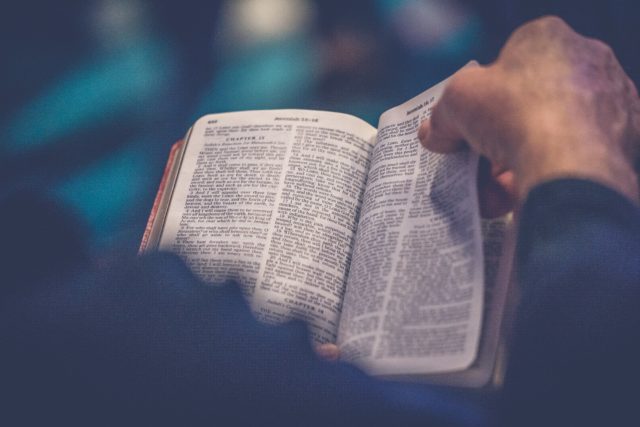
The Bible is God’s message revealed by the Holy Spirit through inspired men (2 Tim. 3:16-17; 1 Cor. 2:13; 14:37). David referred to the work of the Holy Spirit in explaining the origin of the portions of Scripture he wrote. In 2 Samuel 23:1-2, he wrote, “Now these are the last words of David. Thus says David the son of Jesse; Thus says the man raised up on high, The anointed of the God of Jacob, And the sweet psalmist of Israel: ‘The Spirit of the LORD spoke by me, And His word was on my tongue.’” David claimed that the Holy Spirit spoke through him, putting the very words on his tongue. In Mark 12:36, Jesus corroborated this claim by His statement concerning the words of David found in Psalm 110, saying, “For David himself said by the Holy Spirit: “The LORD said to my Lord, ‘Sit at My right hand, Till I make Your enemies Your footstool.’” The process of the Holy Spirit using men, such as David, to write the Old Testament was described by Peter in 2 Peter 1:20-21, “knowing this first, that no prophecy of Scripture is of any private interpretation, for prophecy never came by the will of man, but holy men of God spoke as they were moved by the Holy Spirit.”

Photo by Priscilla Du Pree

The Holy Spirit moved men to write the New Testament as well. While various means were employed by God to communicate His will in the Old Testament, in the New Testament He has spoken by His Son Jesus Christ (Heb. 1:1-2). Inspired men, such as the apostles who heard Jesus themselves, were used by the Holy Spirit to produce the New Testament. We are not left with merely the claim that these individuals were speaking the message of God, but with authentication from God Himself that this message was from Him. This authentication is found in miracles which the Holy Spirit worked. In Hebrews 2:3-4, this question is asked: “how shall we escape if we neglect so great a salvation, which at the first began to be spoken by the Lord, and was confirmed to us by those who heard Him, God also bearing witness both with signs and wonders, with various miracles, and gifts of the Holy Spirit, according to His own will?”  The salvation God provides to us now through His Son was first spoken by the Lord Jesus Christ Himself while He was here on earth and was confirmed by those who heard Him. These were the apostles who accompanied Jesus from the baptism of John to the time of the resurrection, of which they were witnesses (Acts 1:22). Jesus did not reveal all that was to be included in the New Covenant while He was here on earth; there were more truths that the apostles could not yet bear, but they would be guided by the Holy Spirit who would remind them of what Jesus taught them and teach them the remaining portions of the saving truth God desired to reveal. Jesus promised His apostles in John 14:25-26, “These things I have spoken to you while being present with you. But the Helper, the Holy Spirit, whom the Father will send in My name, He will teach you all things, and bring to your remembrance all things that I said to you.” Later, in John 16:13, Jesus promised that the Holy Spirit would guide the apostles into all truth. God bore witness to the veracity of their message that it was indeed from Him, “both with signs and wonders, with various miracles, and gifts of the Holy Spirit” (Heb. 2:4).

Thus, while around forty individuals were used in writing the Bible, there is really one author: God. He has revealed His will for us in the Bible and we can understand it (Eph. 3:4). This coming weekend, Eric Lyons will be here to speak on the abundant evidence for why we can trust the Bible as a reliable guide from God. Will you come?


-Mark Day


Filed Under: Articles, Featured

  • « Previous Page
  • 1
  • …
  • 63
  • 64
  • 65
  • 66
  • 67
  • …
  • 115
  • Next Page »
subscribe"

Contact

Flatwoods Church of Christ
PO Box 871
2100 Argillite Rd.
Flatwoods, KY
41139

606.836.4207

Service Times

Sunday Morning Worship – 9:30 am
Sunday Bible Study – 10:45 am
Sunday Evening Worship – 6:00 pm
Wednesday Evening Worship – 7:00 pm

Featured Posts

Photo by Briana Tozour on Unsplash

2026 Summer Series

Photo by NASA on Unsplash

6.7.26 PM Worship – Todd Parsley – Temporary Things

Winter/Spring 2026 AM Bible Class – Todd Parsley – Romans

Topical Study

Baptism belief bible class bible questions and answers bible study blessing Brandon Foresha bulletin change Chris French Chris Scott christian dispensation christian life David Trimble devo faith faithful family father God gospel Gospel Meeting Greg Hall heaven hope Jerry Sturgill jesus Joy king Mark Day Mark Your Bible Series miracles Nathan Adkins Nathan Parks obedience old covenant Paul peace Phil Sanders Romans salvation sin soul the church Video

Copyright © 2026 · Outreach Pro on Genesis Framework · WordPress · Log in

Loading Comments...