Lesson Audio – Mark Day – The People of God

01.06.19 AM – Bible Class by Jerry Sturgill – Lesson 1 – Healings – Mark 1
01.13.19 AM – Bible Class by Jerry Sturgill – Lesson 2 – The Sabbath – Mark 2-3
01.20.19 AM – Bible Class by Mark Parks – Lesson 3 – Parables – Mark 4
01.27.19 AM – Bible Class by Jerry Sturgill – Lesson 4 – Demon Possession – Mark 5
02.03.19 AM – Bible Class by Jerry Sturgill – Lesson 5 – Healing and Restoration – Mark 5
02.10.19 AM – Bible Class by Jerry Sturgill – Lesson 6 – John the Baptist Executed – Mark 6
02.17.19 AM – Bible Class by Jerry Sturgill – Lesson 7 – Traditions of the Elders – Mark 7
02.24.19 AM – Bible Class by Jerry Sturgill – Lesson 8 – Jesus and Family – Mark 10
03.03.19 AM – Bible Class by Jerry Sturgill – Lesson 9 – Jesus Challenged – Mark 12
03.10.19 AM – Bible Class by Jerry Sturgill – Lesson 10 – The Garden Prayers – Mark 14
03.17.19 AM – Bible Class by Jerry Sturgill – Lesson 11 – Jesus On Trial – Mark 14:53-72
03.24.19 AM – Bible Class by Jerry Sturgill – Lesson 12 – Jesus’ Death and Burial – Mark 15:33-47
03.31.19 AM – Bible Class by Jerry Sturgill – Lesson 13 – Jesus’ Resurrection – Mark 16:1-13
Amos 7:7-9 presents the image of the Lord with a plumb line in His hand. A plumb line was a weight hung from a string; when held up it would show the standard of what was plumb: true vertical. As a mason would hold this up to measure if the wall was truly perpendicular to the ground or whether it was compromised, so the Lord would hold up His standard on Israel.
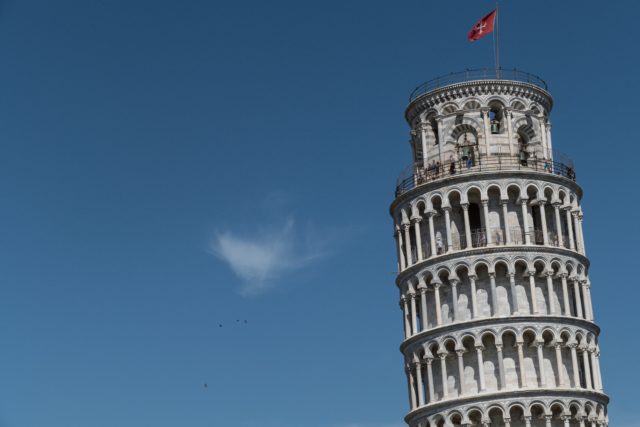
When I was growing up, I learned in elementary school about the fear that the Leaning Tower of Pisa may collapse and the efforts that were being made to stabilize it. Towers fell back in Bible times and caused deaths (Luke 13:4). Everyone remembers where they were when they saw the towers of the World Trade Center collapse on September 11, 2001.
Israel in Amos’ day seemed strong financially. Amos 4:1-3 and 6:1-7 show snapshots of the luxury in which those in power lived. Many were accumulating wealth but were also oppressing the poor (2:6); the rich would bribe their way through legal decisions while the poor had no voice (5:12). They were headed for collapse if they did not straighten up. Through Amos, God called for measures to be taken to correct that which was compromised in their behavior and to stand firm on God’s word. He said, “Seek good, and not evil, that ye may live: and so the LORD, the God of hosts, shall be with you, as ye have spoken” (5:14). The Lord did not want vain worship from people who were mistreating others, instead He pleaded, “But let judgment run down as waters, and righteousness as a mighty stream” (5:24).
However, Israel would not heed. They were not plumb and would not correct the spiritual weaknesses making the wall unsound. So they would fall, “Wherefore thus saith the Holy One of Israel, Because ye despise this word, and trust in oppression and perverseness, and stay thereon: Therefore this iniquity shall be to you as a breach ready to fall, swelling out in a high wall, whose breaking cometh suddenly at an instant” (Isaiah 30:12-13). Immediately after God pronounced that He will set a plumb line in the midst of Israel, He declared, “And the high places of Isaac shall be desolate, and the sanctuaries of Israel shall be laid waste; and I will rise against the house of Jeroboam with the sword” (Amos 7:9). The northern kingdom of Israel, with its reigning dynasty of the house of Jereboam would be destroyed by the Assyrians in 722 BC, about thirty years after the reign Jereboam II.
Today the church of Christ is the Israel of God (Galatian 6:16). Christians are living stones built upon Jesus Christ the solid foundation and cornerstone (1 Peter 2:5-7). We are the spiritual house of Jesus Christ, the Son of David, who fulfilled the prophecy of 2 Samuel 7:13. How do we measure up against the plumb line? Are we a solid, steady pillar that supports the truth (1 Timothy 3:15)? Are we “an holy temple in the Lord” where God dwells among us (Ephesians 2:20-21)? Or have we compromised with the world, seeking sin instead of righteousness? Judgment will come to the house of God that does not stand plumb on His truth just as it did on Israel in the Old Testament and to the temple in the first century AD (1 Peter 4:17).
-Mark Day
 Speaker for “In Search of the Lord’s Way,” a nationally broadcasted television ministry of Edmond Church of Christ since 2009. Involved in active ministry for more than 48 years. Adjunct Professor for Georgia School of Preaching, Marietta, GA and for Asian Christian University, Philippines. Served as Instructor, Nashville School of Preaching and Biblical Studies for eleven years. Served as Instructor, Amridge University for six years. Board member of Lads to Leaders. Author of several books and frequent speaker at lectureships, gospel meetings and seminars. Articles in Gospel Advocate and Spiritual Sword. Author of A New Life, 2015. A Faith Built on Sand, 2011. Adrift: Postmodernism in the Church, 2000. Let All the Earth Keep Silence, 2006. Evangelism Handbook of New Testament Christianity, 2009. A New Life, 2015 Several books are online. In Search of the Lord’s Way PO Box 371, Edmond, OK 73083