Flatwoods church of Christ

  • Home
  • News
  • Media
    • Articles
    • Bible Studies
    • Gospel Meeting
    • Lesson Audio
    • Video
  • Members
  • Peru Mission
  • About Us
    • Plan of Salvation
    • Staff, Elders, and Deacons
  • Library
    • Correspondence Course
    • Links
    • Preach the Word
  • Visit
    • What To Expect
  • Contact
You are here: Home / Archives for Media

Lesson Audio – What’s Right with the Church

August 30, 2015 by admin Leave a Comment

church

https://flatwoodschurchofchrist.org/wp-content/uploads/2015/08/T073_08.30.15-am-Jerry-Sturgill-Whats-Right-with-the-Church.mp3

Filed Under: Lesson Audio

Paul’s Work Ethic at Thessalonica

August 27, 2015 by admin Leave a Comment

The apostle Paul lived in such a way that his life would be an example to others. There were some in the Thessalonian congregation that refused to work, who needed to imitate the work ethic of Paul. Paul wrote in 2 Thessalonians 3:7-9, “For yourselves know how ye ought to follow us: for we behaved not ourselves disorderly among you; Neither did we eat any man’s bread for nought; but wrought with labour and travail night and day, that we might not be chargeable to any of you: Not because we have not power, but to make ourselves an ensample unto you to follow us.”

bread

Paul particularly mentioned that he did not eat any man’s bread without paying for it. Now, Paul is not talking about simply going to someone’s house for dinner; “to eat bread” is equivalent to our expression “put food on the table.” “Bread” among the Jews was a term sometimes used for eating food in general (1 Samuel 20:34; 28:20; 1 Kings 21:5; Psalm 41:9; 102:9); moreover, “to eat bread” stood for making a living (Amos 7:12). The connection between working and eating has its roots early in the Bible going back at least to the principles of Genesis 3:19. The Old Testament touches on this principle time and again (Psalm 128:2; Proverbs 10:4; 12:11; 19:15). If one is able to work, then work should be done to support self and help others who are in legitimate need (Ephesians 4:28).

Paul, Silas, and Timothy were not motivated by greed when they came to Thessalonica (1 Thess. 2:5), but came to save souls. To demonstrate this lack of covetousness among them, they refused to be a financial burden on anyone (1 Thess. 2:9), but instead made their own living. While many of the social elite of the first-century Greco-Roman culture regarded manual labor as degrading, Paul did not underplay but in fact highlighted his own manual labor in establishing his upstanding character (1 Thess. 2:9).

Paul did teach that financial support for preaching and other Christian service was acceptable, but on several occasions he did not make use of this privilege (2 Thess. 3:9; 1 Cor. 9:7-14; Gal. 6:6; 1 Tim. 5:17-18; cf. Matt. 10:10). One is not fit to be supported for Christian service if his ministry is motivated solely by financial gain (Acts 20:33; 1 Tim. 3:3, 8; 6:9-10; Titus 1:7; Heb. 13:5; 1 Pet. 5:2; 2 Pet. 2:3). Many philosophers and religious leaders of the day looked for patrons to support them, but Paul, Silas, and Timothy avoided this practice, making themselves a model for the church to follow.

In the epistle of 2 Thessalonians, Paul returns to the teaching on work given at their initial visit: “For even when we were with you, this we commanded you, if any would not work, neither should he eat” (2 Thess. 3:10). God’s response to one who could work but refuses is essentially, “You choose not to work? Then you choose not to have the necessities of life when you need them.” Often there is a mistaken notion of charity today, where “the Christian thing to do is always provide for the needs of others” even when they could provide for themselves. This is not Christian; it is not what the Bible teaches. While 2 Thessalonians 3 commands that we be merciful and do good (2 Thess. 3:13), it also prohibits us from enabling someone in a life of freeloading (2 Thess. 3:10-11).


–Mark Day

Filed Under: Articles

Lesson Audio – JOY

August 26, 2015 by admin Leave a Comment

joy
08.23.15 pm – Chris Scott – JOY
https://flatwoodschurchofchrist.org/wp-content/uploads/2015/08/T072_08.23.15-pm-Chris-Scott-JOY.mp3

Filed Under: Lesson Audio

Lesson Audio – God’s Plumbline

August 26, 2015 by admin Leave a Comment

tool builder
08.23.15 am – Nathan Adkins – God’s Plumbline
https://flatwoodschurchofchrist.org/wp-content/uploads/2015/08/T071_08.23.15-am-Nathan-Adkins-Gods-Plumbline.mp3

Filed Under: Lesson Audio

Worthy of Death

August 21, 2015 by admin Leave a Comment

Paul said before Festus in Acts 25:11, “For if I be an offender, or have committed any thing worthy of death, I refuse not to die: but if there be none of these things whereof these accuse me, no man may deliver me unto them. I appeal unto Caesar.” While Paul had not committed any crime that warranted capital punishment, he maintained that if he had committed such a crime he would not try to get out of it, but would receive death as a just punishment.

fence-690578_1280
Obviously, there are many crimes a man may commit that do not deserve his death, but the Bible does teach the fact that some crimes do warrant the death penalty. Under the law of Moses, God instructed for various punishments to fit various crimes. Some crimes necessitated a fine (Exodus 21:19), other crimes caused those who perpetrated them to be “worthy to be beaten” (Deuteronomy 25:2); however, there were certain crimes that were so serious that those responsible for such acts were considered “worthy of death” (Deuteronomy 17:6; 19:6; 21:22).

We are no longer under the Old Testament, and there are many differences between governments today and the theocracy that once was in place in Israel. However, the New Testament does speak of those who are “worthy of death” (Acts 25:11; Romans 1:32); moreover, it prescribes government “a revenger to execute wrath” upon the evildoer, that “beareth not the sword in vain” (Romans 13:4). What would “the sword” mean here but the carrying out of capital punishment?

The three purposes of punishment in general are restraint (to keep others from doing this crime), reformation (to cause people to do better and not continue committing the crime), and retribution (because the perpetrator deserves punishment). While the Bible certainly teaches restraint and reformation, the most fundamental of these three purposes is retribution. Yes, it is important to deter others from committing crimes; yes, it is important to try to reform individuals to do better. However, what we often miss in today’s society is the principle of retribution: that punishment is deserved.

Even though he was uninspired, the penitent thief on the cross even recognized this fundamental Bible truth:
“And one of the malefactors which were hanged railed on him, saying, If thou be Christ, save thyself and us. But the other answering rebuked him, saying, Dost not thou fear God, seeing thou art in the same condemnation? And we indeed justly; for we receive the due reward of our deeds: but this man hath done nothing amiss.” Luke 23:39-41

This malefactor did not try to blame someone else for his crime. He did not act like a victim. While in the midst of suffering the pain of crucifixion, he recognized that this was being done “justly” to him and the other malefactor for both were receiving the “due reward” for their deeds.

-Mark Day

Filed Under: Articles

  • « Previous Page
  • 1
  • …
  • 409
  • 410
  • 411
  • 412
  • 413
  • …
  • 446
  • Next Page »
subscribe"

Contact

Flatwoods Church of Christ
PO Box 871
2100 Argillite Rd.
Flatwoods, KY
41139

606.836.4207

Service Times

Sunday Morning Worship – 9:30 am
Sunday Bible Study – 10:45 am
Sunday Evening Worship – 6:00 pm
Wednesday Evening Worship – 7:00 pm

Featured Posts

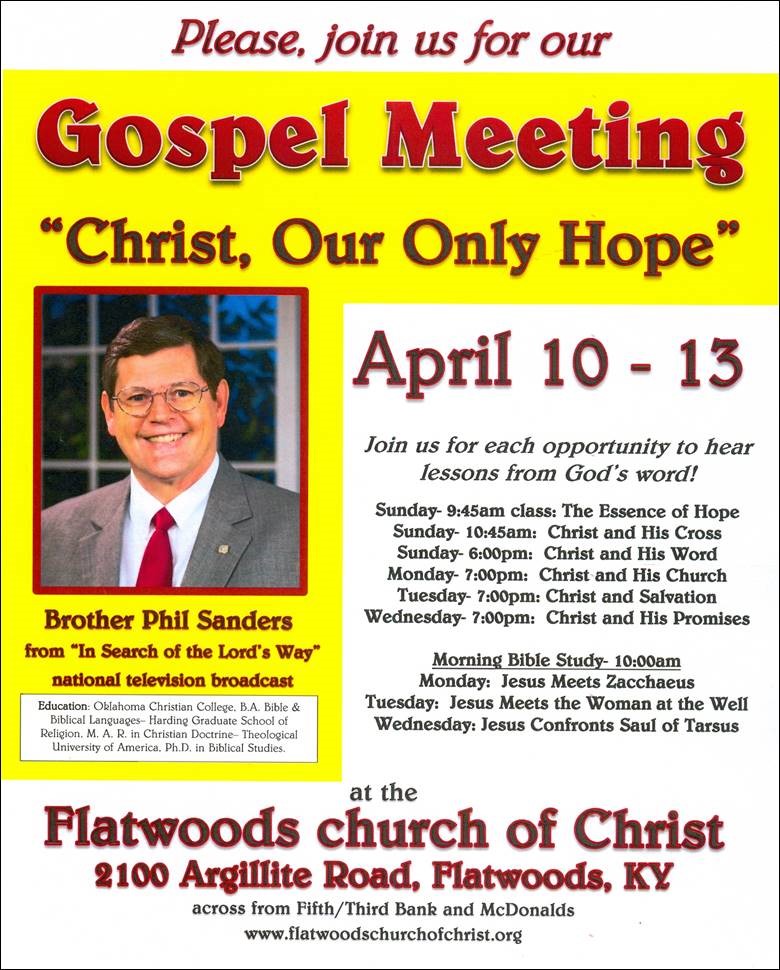
Spring 2026 Gospel Meeting with Phil Sanders – April 19-22

Photo by Sincerely Media on Unsplash

Gospel Meeting

Photo by Luis Georg Müller on Unsplash

4.15.26 Wednesday Bible Study – Devo by Chris Scott – Living My Best Life

Topical Study

Baptism belief bible class bible questions and answers bible study blessing Brandon Foresha bulletin change Chris French Chris Scott christian dispensation christian life David Trimble devo faith faithful family father God gospel Gospel Meeting Greg Hall heaven hope Jerry Sturgill jesus Joy king Mark Day Mark Your Bible Series miracles Nathan Adkins Nathan Parks obedience old covenant Paul peace Phil Sanders Romans salvation sin soul the church Video

Copyright © 2026 · Outreach Pro on Genesis Framework · WordPress · Log in


Loading Comments...