Jesus and the Old Testament: Canon, Inspiration and History
How did our Lord view the written oracles of God? How did He use God’s word while He lived among men for a third of a century? Since Jesus is our example (1 Pet. 2:21), we should allow His approach to Scripture to influence our approach.
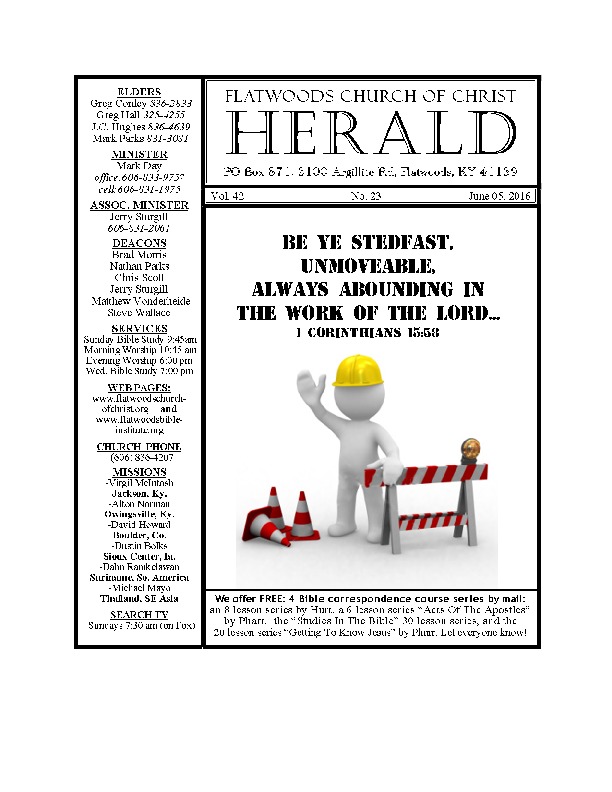
Jesus recognized the true Old Testament canon. The word canon refers to a measuring rod; those books that are considered canonical are those which “measure up” to the characteristics of inspired writing. Our English Old Testaments today are comprised of 39 books. While several other books were circulated among the Jews, most frequently referred to as today as “the Apocrypha,” Jesus only recognized the material that comprises our 39 books as part of the canon. In Matthew 23:35, He said, in essence, from the beginning to end of the Old Testament, all the blood of the righteous would be required of that generation; thus, he delineated the ends of the Old Testament referring to Abel, the first martyr recorded in Genesis, to Zechariah son of Barachias, the last martyr mentioned in 2 Chronicles (the last book in the Jewish order of the Old Testament).

Jesus viewed the Old Testament as inspired and historically accurate. Instead of considering the first eleven chapters of Genesis as a fable, or reinterpreting the creation account in order to fit billions of years between creation and the coming of man, Jesus spoke of Adam and Eve in Mark 10:6 saying, “from the beginning of creation God made them male and female.” He considered the devil to be real, referring to him as “murderer from the beginning” and a “liar” (Jn. 8:44). The account of the days of Noah in Genesis 6 was a reality that he likened to the time when He would come (Lk. 17:26-27). Abraham (Jn. 8:56), Isaac and Jacob (Mt. 8:11) were historical figures in His mind. The demise of Lot’s wife, while laughed at by some today, was considered a real story with a sobering lesson by our Lord (Luke 17:32); moreover, that the cities of Sodom and Gomorrah were destroyed was an historical fact that Jesus used to show the reality of God’s final judgment (Matthew 10:15). Jesus believed that God really spoke to Moses through a burning bush (Mk. 12:26), that Moses made the bronze serpent and lifted it up for Israel to be cured (Jn. 3:14), and that Moses received God’s commands and wrote the law (Mt. 8:4; Mk. 10:3;Lk. 24:44; Jn. 5:46; et. al.); should we not believe the same?
Christ not only believed in the inspiration of the law, but the other portions of the Old Testament as well. Jesus used David’s actions recorded in 1 Samuel 21 as inspired proof in His argument with the Pharisees over the Sabbath (Mt. 12:4). On another occasion, He quoted David’s words from Psalm 110, saying “David himself said by the Holy Ghost” (Mk. 12:36); thus, Jesus believed David was inspired. Jesus often referred to the prophets as part of God’s inspired word (Mt. 5:17; 7:12; 11:13; 22:40). He recognized God’s prophets of the Old Testament were persecuted because they spoke the truth (Mt. 5:12; 23:34) while the false prophets were lauded (Lk. 6:26). Jesus even considered the preaching of Jonah and his sojourn in the belly of a great fish to be just as historically accurate as His own death and resurrection; He even placed it aside the historical account of the Queen of Sheba visiting Solomon (Mt. 12:39-42). While legendary materials can be used as illustrations, it is hard to interpret Jesus’ use of Jonah as anything other than the use of historical material to make His point.
On and on we could go. Suffice it to say that those portions of the Old Testament that have been questioned or dismissed by some today as mythical or composed by uninspired men, Jesus considers historical and inspired. Jesus is the truth (Jn. 14:6), and we should side with Him.
–Mark Day
Lesson Audio – Mark Day – It’s Too Much to Go to Jerusalem

Scripture Reading: I Kings 12:26-29
11.08.15 pm – Mark Day – It’s Too Much to Go to Jerusalem
Lesson Audio – Mark Day – Declared to be the Son of God
When Eternal Punishment Is Expunged

The scriptures absolutely affirm the reality of eternal punishment for the wicked after this life (Mt. 25:30, 41, 46; 2 Thess. 1:9; Rev. 21:8). Jesus Christ Himself is the most explicit of all God’s representatives about this teaching (Mt. 5:22; 29-30; 8:12; 10:28; 23:15; Mark 9:42-49; et al.). However, it is difficult for us to psychologically wrap our heads around the idea of people suffering eternally. We certainly do not like to think about it. Many are tempted to deny this grim reality that awaits the wicked in spite of the clarity of the scriptures regarding it. Instead of working to save people from hell, many wish to save people from the fear of hell; thus they attempt to reinterpret those Bible verses which teach its reality. But perverting God’s teaching on eternal punishment does not merely affect the meaning of a few verses, it changes the meaning of those biblical doctrines that we hold most precious. Consider a few:
1. Removing hell ruins the meaning of salvation. Salvation is precious because of what we have been saved from. Because of sin, we all deserve to die eternally (Rom. 3:23; 6:23), and we are so thankful to God that we do not have to meet the end we deserve (Rom. 7:24-25). But if we remove any idea of God’s wrath upon those who disobey Him, then we remove the significance of salvation. Unless we have been saved from real danger there is no meaning in salvation.
2. Removing hell ruins the preciousness of heaven. Though the Bible describes both destinations with equal certainty, the majority of people are willing to accept the idea of heaven, but deny the reality of hell. For years, surveys of common beliefs regarding what happens after death have shown this to be true. However, unless evil men are dealt with and separated from the saved, then heaven becomes populated with the same wicked people which plague the earth. Now, don’t get me wrong, I desire that all wicked people repent and be saved because that is what God desires (1 Tim. 2:4; 2 Pet. 3:9), but what shall be done with those who continue in wickedness? If they are never punished, nor separated from the good, then heaven is merely a recreated situation of our present earthly state. Heaven, then, is not a precious promise to the faithful, but just earthly life moved to another realm.
3. Removing hell ruins the integrity of our Lord. If we begin to embrace the idea that Lord may not carry through with His pledge to destroy the wicked, but instead reverse their fate, then how can we count on anything He says? If God has said something about the eternal destiny of the wicked that is not trustworthy, then how can we regard His promises to bless those who follow Him as trustworthy (Titus 1:2)? We either can count on what He says in His word or we cannot. A willful denial of clear teaching from the Bible on any particular topic because we do not like it equals a denial of the Bible altogether as a means of molding our beliefs.
We destroy much more than hell when we remove it from our set of beliefs. Seeing it is so clearly taught, and so inseparably woven into other teachings of God, we ought to respond to the doctrine of hell, not by denying it, but by doing our utmost to avoid it and teaching others to do the same.
–Mark Day
- « Previous Page
- 1
- …
- 565
- 566
- 567
- 568
- 569
- …
- 620
- Next Page »